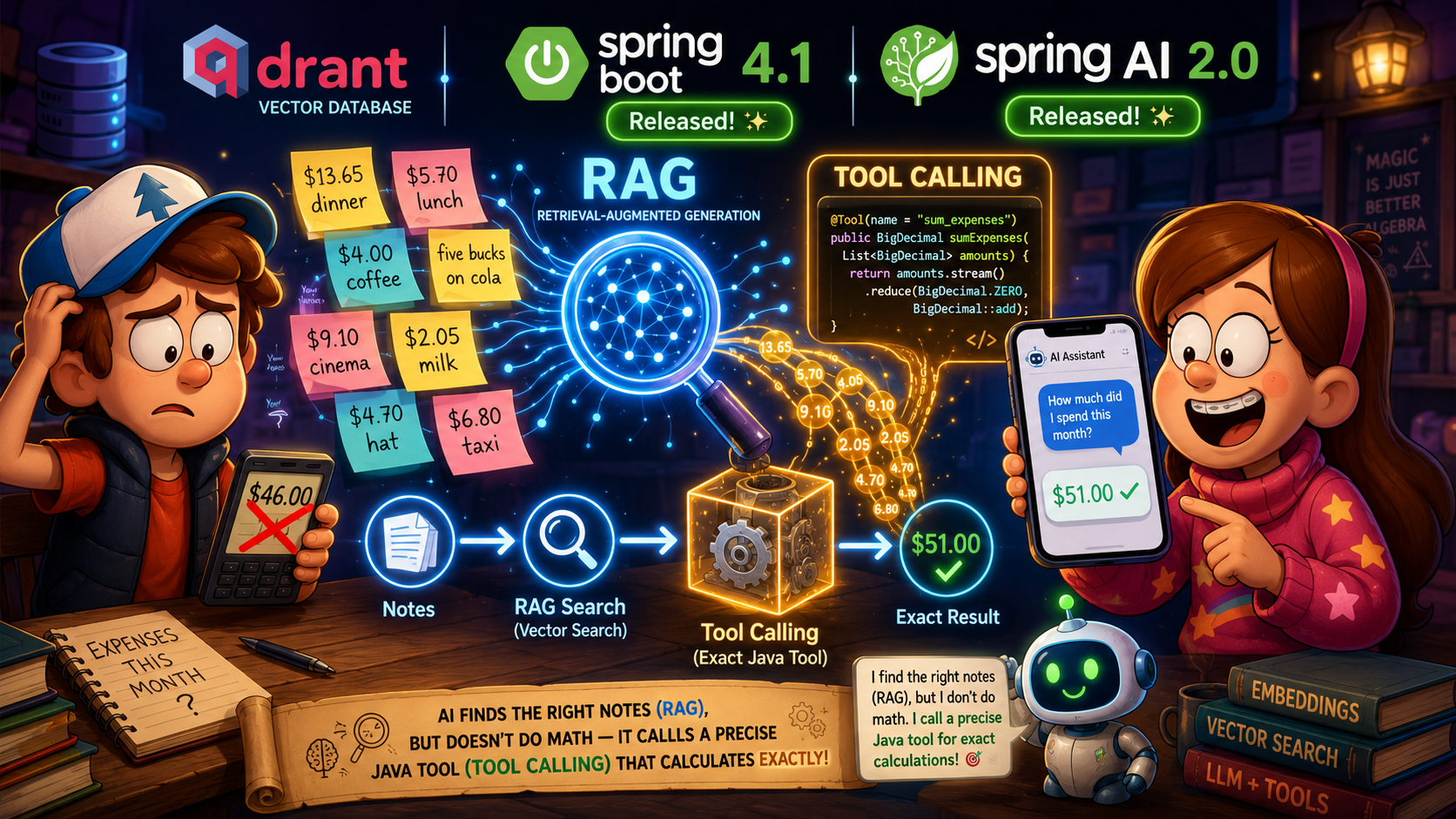
Learn how to build an intelligent note-taking application using RAG (Retrieval-Augmented Generation) with Spring Boot 4.1, Spring AI 2.0, and Qdrant vector database. Includes Tool Calling for accurate expense calculations.

From Sticky Notes to Smart Answers: RAG Implementation with Spring Boot 4.1 & Spring AI 2.0

In previous articles, we integrated local LLMs for test generation and set up semantic search with Qdrant. Now it’s time to tie these ideas together and build a proper RAG application. We’ll create a service that can retrieve relevant notes, pass them into an LLM context, and — crucially — use Tool Calling to perform exact calculations. Using monthly expense tracking as our example, we’ll see how Spring AI 2.0 and Spring Boot 4.1 help unify search, generation, and external tools into a cohesive, reliable solution. ...
June 23, 2026 · 6 min · Alexey Y.
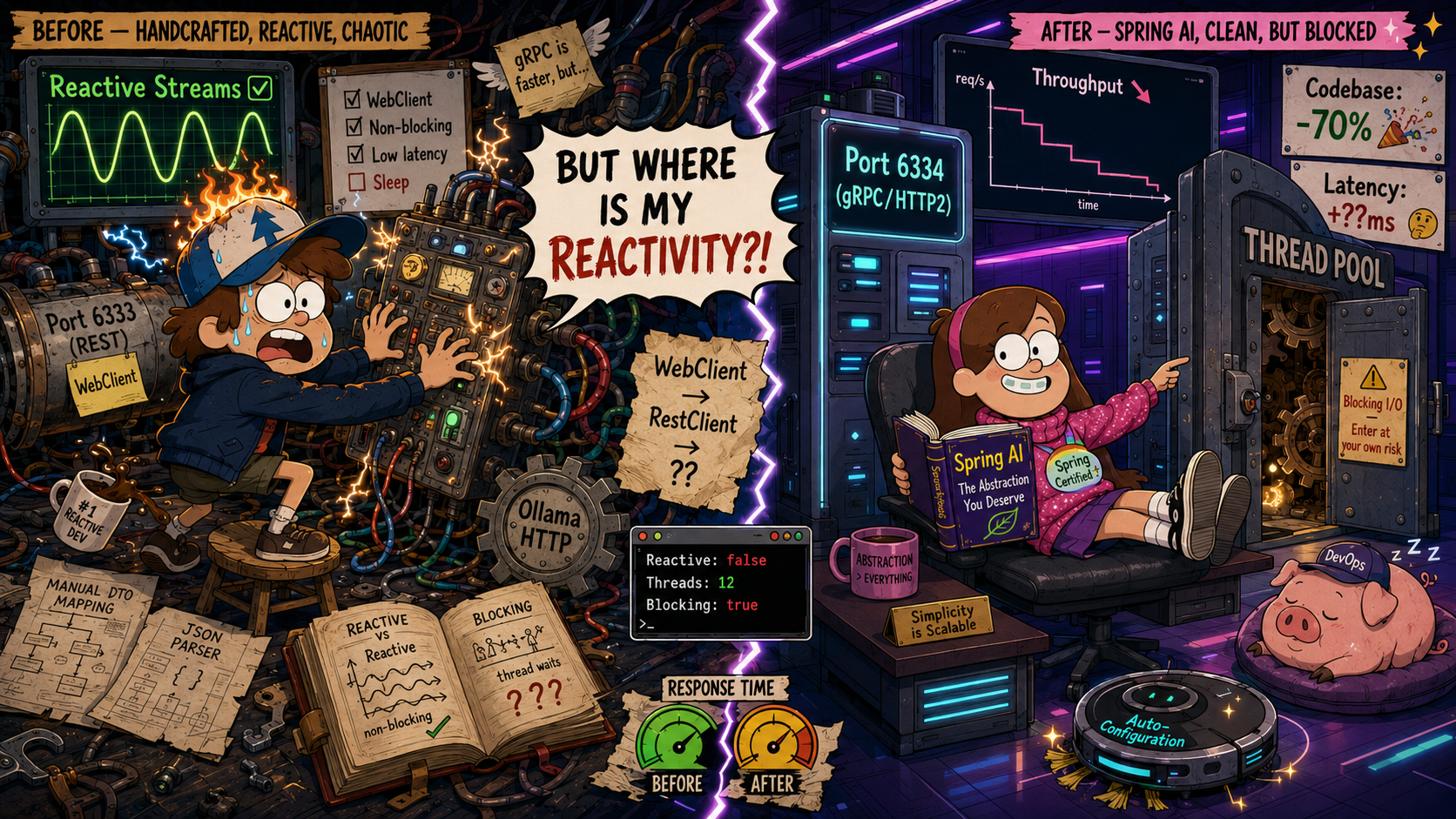
Lessons Learned: Spring AI vs Handcrafted Integration

WebClient Was Fast. Spring AI Was Easy. I Chose .... Here's What Happened.

This note is a continuation of the previous part. The motivation was to compare approaches to implementing the integration with AI: Ollama: responsible to calculate embeddings vectors Vector database, Qdrant in our case: responsible to keep and search Notes Let’s start with a summary. This conclusion was obvious even before touching the code, but after playing around, it has been confirmed. Better to start with Spring AI if integration is needed. It provides a good abstraction layer, including: ...

June 18, 2026 · 3 min · Alexey Y.